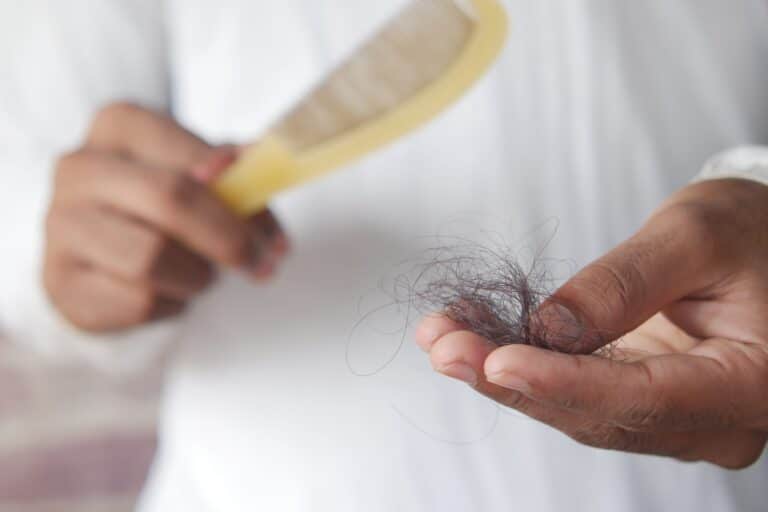
Key Takeaways:
- A receding hairline and thinning crown point to male pattern baldness, whereas a widening part and overall thinning on top usually mean female pattern hair loss.
- DHT drives most cases in men, while in women, thinning is often tangled up with other factors such as menopause, pregnancy, thyroid issues, or PCOS.
- Complete baldness is rare for women. The front hairline almost always survives, even when thinning further back becomes severe.
- Minoxidil and PRP work for both sexes. Finasteride and hair transplants are different.
A man losing his hair and a woman losing hers could be dealing with the same gene, expressed in two completely different ways. This can be confusing for many reasons.
Anyone looking up “male vs. female pattern baldness” online can find plenty of overlap in the biology. But the actual pattern on someone’s scalp, the workup a doctor runs, and what actually gets prescribed often look nothing alike.
Recognizing the Pattern
-
Hair Loss for Men
Picture the classic bald spot people complain about, and you’re picturing male pattern baldness. This might look like temples receding into an M shape, then a bald patch opening up at the crown, until eventually the two meet in the middle.
Dermatologists grade this on the Norwood scale, which spans seven stages from barely-there recession to nothing left but a horseshoe of hair around the sides. If you compare men vs. women, the latter rarely experience baldness this way.
-
Hair Loss for Women
In women, the part just gets wider and wider, and thinning spreads across the crown rather than concentrating in one spot. The front hairline usually holds its ground, but that’s graded differently too, on the Ludwig scale.
Rather than measuring where the hairline sits, the scale evaluates how much scalp shows through at the part. This could be why it’s the single most reliable way to tell female vs. male pattern hair loss apart on sight.
Knowing the Difference: Total baldness up top is mostly a male thing. By contrast, women thin out; they don’t usually go bald.
What Causes Hair Loss for Females vs. Males?
Both trace back to DHT, a byproduct of testosterone that shrinks a hair follicle a little more with each growth cycle until it stops producing a visible hair. Genetics determines which follicles are sensitive, which is why baldness runs in families but can skip a brother or hit a nephew nobody expected. For men, that’s usually the whole story.
For women, it’s rarely that simple to find out why you may be losing hair. DHT sensitivity is still in play, but menopause, pregnancy, thyroid disease, and PCOS all throw hormones into the mix too. Estrogen seems to guard hair follicles to some degree, so when it drops off around menopause, thinning often speeds up.
That tangle of causes is a big reason male vs. female pattern baldness tends to get treated as two separate diagnoses in practice, not one condition with two faces.
Diagnosis Looks Different Too
A man with a textbook receding hairline can often get diagnosed from a visual exam alone. But cases of hair loss in women are more likely to begin with a lab order. This checks thyroid function, ferritin, and hormone levels.
These different diagnostic protocols for male vs. female pattern baldness exist because diffuse thinning in women can also point to something else entirely, such as telogen effluvium. So ruling out other possibilities makes sense before starting treatment or prescribing medication.
Treatment Options for Male vs. Female Pattern Hair Loss
-
Minoxidil, PRP, Laser Caps
Minoxidil is approved for both and remains the most reliable first step, regardless of who’s using it. PRP injections for hair loss and low-level laser caps also show benefit in both sexes, though results vary from person to person.
-
Finasteride
Finasteride is a go-to for men, but not for women of childbearing age because of the risk to a developing fetus. Spironolactone and other anti-androgens sometimes fill that gap for women instead, depending on what’s driving the thinning.
-
Transplants
Men keep a stable band of donor hair at the back of the head, which makes them good candidates for hair transplants almost by default. However, women with thinning spread across the whole scalp, including the donor zone, don’t always have enough density back there to harvest from.
None of this means male vs. female pattern baldness is worse. It only means that the same phrase, “pattern hair loss”, hides two different diagnoses depending on who’s in the chair. Instead of assuming a treatment built for one sex will work for the other, the best way to get your hair growing back is a personalized consultation for your scalp.

Dr. Robert Niedbalski has been helping patients with hair loss for over 25 years. His practice is dedicated to the very highest level of care and is successful thanks to a combination of attention to patient needs and support for his staff. He and his team at Northwest Hair Restoration serve Tacoma, Seattle, and Spokane.