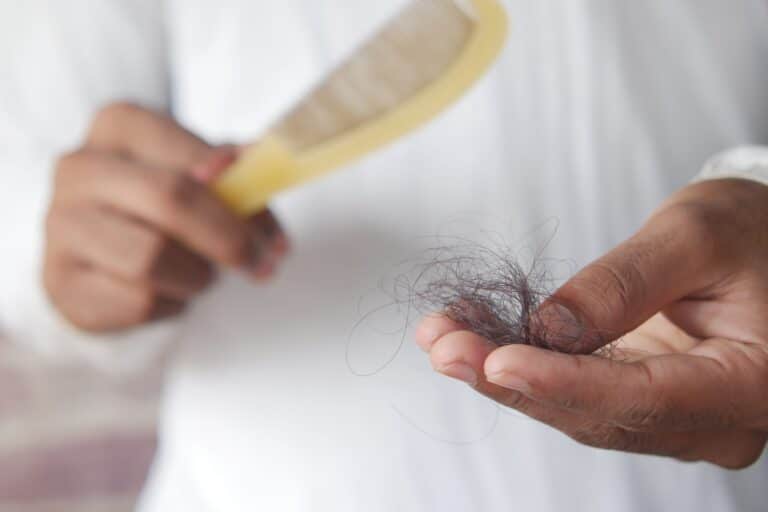
Hair loss is a common concern that affects countless individuals worldwide. While factors such as age, stress, and certain medical conditions can contribute to hair loss, genetics often play a significant role.
Understanding the genetic aspects of hair loss can provide valuable insights into why hair loss occurs and how it can be managed or treated.
Let’s discuss hair loss, the role of genetics in hair loss, and what you need to know.
Hair Loss: What is It?
Hair loss, medically known as alopecia, is a condition where hair from the scalp or body begins to fall out in higher-than-normal amounts. It can occur gradually over time or suddenly, and it can affect just your scalp or your entire body.
There are several types of hair loss, some of which are:
- Androgenic alopecia: This is also known as male or female pattern baldness and is the most common type of hair loss.
- Telogen effluvium: A temporary form of hair loss where changes in the number of hair follicles growing hair lead to increased shedding and thinning.
- Anagen effluvium: This is generally due to internally administered medications, such as chemotherapy agents, that poison the growing hair follicle.
- Traction alopecia: Hair loss caused by pulling on the hair, which can happen with tight hairstyles like ponytails, braids, or buns.
- Cicatricial (scarring) alopecia: This rare disease occurs when inflammation damages and scars the hair follicle, causing permanent hair loss.
Understanding Genetics and Hair Loss
Hair loss, specifically androgenetic alopecia (also known as male or female pattern baldness), has a strong genetic component. Androgenetic alopecia is characterized by a progressive thinning of the hair, predominantly on the top and front of the scalp.
It affects both men and women, although the pattern of hair loss differs between the sexes.
The primary genes involved in hair loss are located on the X chromosome, which men inherit from their mothers. However, recent research suggests that other genes, not just those inherited from the mother, contribute to male pattern baldness. This means that if baldness is in your family history, you may be more likely to experience it too.
It’s worth noting that while genetics certainly play a role in hair loss, they don’t tell the whole story. Just because you have a family history of baldness doesn’t necessarily mean you’ll lose your hair too. Environmental factors, lifestyle choices, and overall health can all influence hair loss.
The Role of DHT
The relationship between genetics and hair loss is largely due to a hormone called dihydrotestosterone (DHT). Certain individuals are genetically predisposed to have hair follicles that are sensitive to DHT.
When exposed to DHT, these sensitive follicles shrink, leading to a shorter lifespan and the production of thinner, shorter hairs, a process known as miniaturization.
Managing and Treating Genetic Hair Loss
Unfortunately, genetic hair loss cannot be prevented entirely. However, it can be managed and treated effectively. The first step is to get a proper diagnosis from a hair loss specialist. They can assess your hair loss pattern, consider your family history, and suggest appropriate treatment options.
Several treatments are available for genetic hair loss, including:
- Medications: They work by slowing hair loss and, in some cases, promoting new hair growth.
- Laser Therapy: This therapy is non-invasive and uses light energy to stimulate hair growth.
- Hair Transplant Surgery: This is a more permanent solution where hair follicles from one part of the scalp are transplanted to the thinning or balding areas.
Hair Loss Treatment in Tacoma, Seattle, and Spokane, WA
At Northwest Hair Restoration, we understand the role genetics plays in hair loss. Our highly skilled and experienced team, led by Dr. Robert Niedbalski, is dedicated to helping you maintain what you have and restore what’s been lost. We offer the latest surgical and nonsurgical treatments tailored to your unique needs and expectations.
From follicular unit extraction (FUE) and follicular unit transplantation (FUT) procedures, our innovative solutions are designed to address hair loss at its root cause and stimulate the growth of new, natural-looking hair.
For more information or to see our hair loss specialist, call us today at (253) 572-2949 or fill out our online appointment request form. We look forward to serving you!

Dr. Robert Niedbalski has been helping patients with hair loss for over 25 years. His practice is dedicated to the very highest level of care and is successful thanks to a combination of attention to patient needs and support for his staff. He and his team at Northwest Hair Restoration serve Tacoma, Seattle, and Spokane.